

Your singil sa ilaw arrives. You open it. PHP 6,200. Meralco's generation charge has climbed roughly 8% year-over-year — that bill is not a fluke, it is the new baseline. For every Filipino homeowner stuck on the grid, the same math keeps surfacing: at what point does solar beat Meralco on pure cost? This Meralco vs solar power Philippines cost comparison cuts straight to the peso amounts, the payback period, and a clear verdict.
Short answer: for most households paying PHP 3,500 or more a month, that point was yesterday.
- Meralco's all-in rate sits at approximately PHP 9.00–10.50/kWh as of mid-2026 (VECO/CEBECO rates differ slightly by region)
- A 300kWh/month household pays roughly PHP 3,900/month on Meralco — PHP 468,000 over ten years
- A 5kWp solar system costs PHP 250,000–320,000 installed; payback period is typically 5–7 years
- After payback: roughly 18–19 years of near-free kuryente
- Solar wins if your bill is consistently PHP 3,000+ and you own the property
Magkano ang Meralco Bill Mo vs. What Solar Actually Costs You
Real peso numbers. No percentages, no projections dressed up as facts. A household consuming around 300 kWh per month pays approximately PHP 3,900 on Meralco right now — generation charge, distribution, transmission, system loss, all of it baked in. That same household on a properly sized solar system with net metering pays PHP 150–400 per month. Most of that residual is Meralco's mandatory minimum service charge — the one line item you cannot escape. Your actual energy consumption? The sun handles it.

Homeowners in the Visayas on VECO or CEBECO will see slightly different base rates, but the trajectory is identical — distribution utilities across the Philippines have tracked the same upward climb as Meralco for years.
| Cost Comparison | Meralco Only | With Solar + Net Metering |
|---|---|---|
| Monthly bill | PHP 3,900 | PHP 150–400 |
| Annual cost | PHP 46,800 | PHP 1,800–4,800 |
| 10-year cost | PHP 468,000 | PHP 18,000–48,000 + system cost (recoverable) |
Paano Mo Mababawi ang Solar Investment? (The Real Payback Math)
People hear PHP 300,000 and panic. That is the wrong reaction. That is not an expense — it is a capital investment with a known, calculable return. A homeowner in Antipolo with a PHP 5,200/month Meralco bill who goes solar drops to roughly PHP 200/month after installation. PHP 5,000 in monthly savings. PHP 60,000 a year. The investment pays itself back and then keeps generating returns for two more decades.
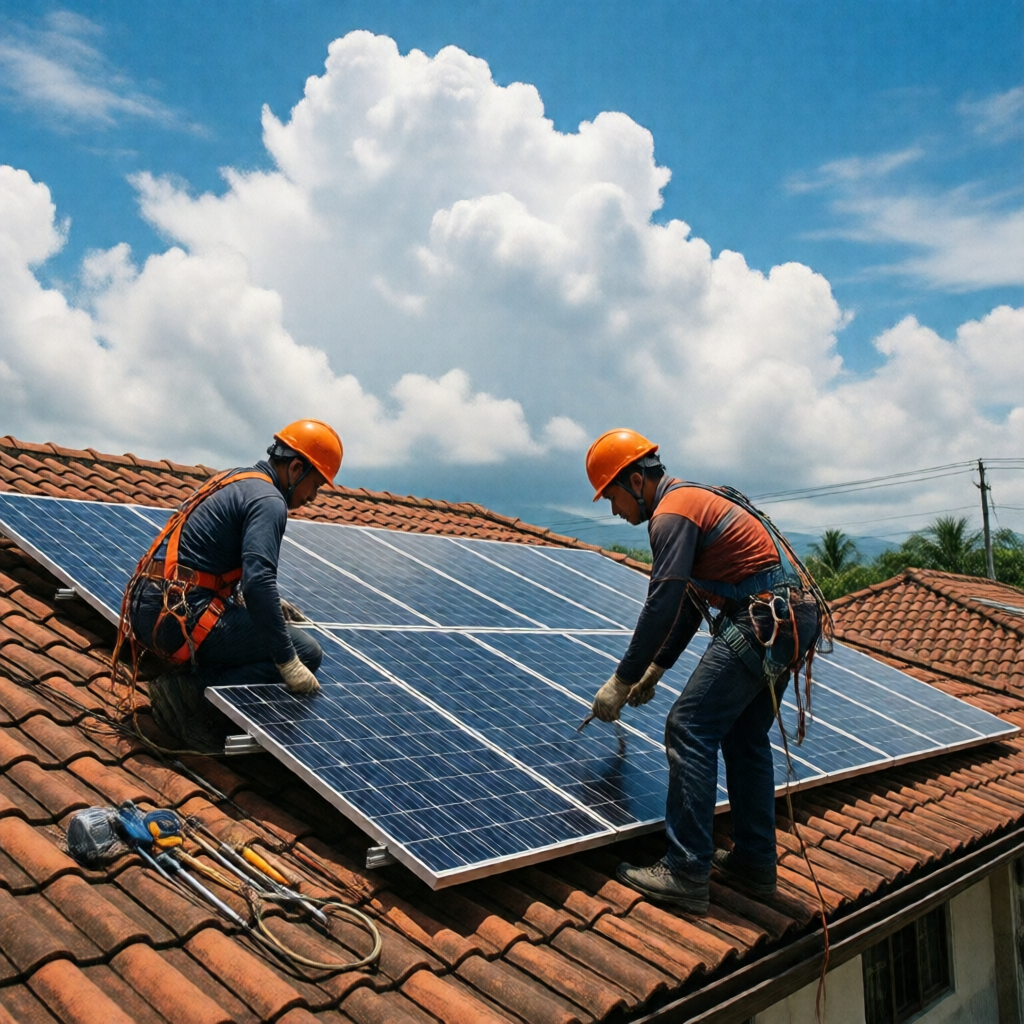
Net metering sharpens the numbers further. Excess power your system generates during the day gets pushed back to the grid, and Meralco credits it against your bill. When you are at work and the panels are running full blast, you are banking kilowatts for later. Free. You can read the full net metering application process here — it is more straightforward than most people expect.
Areas prone to brownouts benefit from a hybrid system with battery storage. That runs PHP 380,000–500,000 — more upfront, but it also solves a grid reliability problem that has nothing to do with solar generation itself.
The Philippines receives some of the highest solar irradiance in Southeast Asia, with most regions averaging 4.5–5.5 peak sun hours per day according to IRENA and NREL solar resource maps. Your location is not a liability — it is an asset Meralco cannot charge you for.
So, Sulit Ba? Who Should Switch to Solar Right Now
This is not a complicated decision. Solar wins if your monthly kuryente bill is consistently PHP 3,000 or more, you own your home, and your roof gets reasonable sun exposure — which, in the Philippines, is almost everywhere.

Stick with Meralco if your bill is under PHP 2,000/month — the payback period stretches too long. Same calculation if you are renting, or planning to move within five years. Solar is a property investment. It makes no sense on a property you do not own.
But for a Philippine homeowner with a bill above PHP 3,500? This is one of the highest-return investments available. Not a lifestyle upgrade. Not a green statement. Basic math.
Mga Tanong na Madalas Itanong (FAQ)
How much does it cost to switch from Meralco to solar in the Philippines in 2026?
A standard 5kWp residential solar system costs PHP 250,000–320,000 fully installed — panels, inverter, and labor included. At current Meralco rates, most Metro Manila homeowners recover this within 5–7 years, then run on near-free electricity for the remaining 18-plus years of the system's life.
Can I completely eliminate my Meralco bill with solar?
For most households, yes — or close enough to matter. A properly sized system offsets 80–100% of consumption, with net metering credits reducing monthly charges to roughly PHP 40–80 (Meralco's mandatory minimum service charge, which is unavoidable).
Is solar still worth it if Meralco rates go down?
Meralco rates have increased every year for the past decade, and the structural drivers — fuel costs, distribution upgrades, system loss charges — all trend upward. Even at today's flat rates, solar wins financially over 25 years; any rate increase from here only shortens your payback period.
Are there government incentives or financing options for solar in the Philippines?
Yes on both counts. The Renewable Energy Act (RA 9513) exempts solar equipment from VAT and import duties, reducing upfront costs by roughly 12%. For financing, most major banks (BDO, BPI, Metrobank) offer home improvement loans that cover solar installations, and many solar companies — including LakaSolar — offer in-house installment plans that bring the monthly outlay below your current Meralco bill from day one.
The Bottom Line
Ang Meralco rate ngayon — PHP 9–10.50 per kWh at climbing — is the single strongest argument for going solar in 2026. A 5kWp system pays for itself in 5–7 years, then generates free electricity for two more decades. Net metering turns your roof into a revenue stream. Government incentives remove the VAT burden. Financing options bring the upfront cost within reach of a typical Metro Manila household.
The question is no longer if solar makes sense in the Philippines. The numbers settled that. The only question left is when you start the clock on your payback period.
Quick Savings Estimate
Get a Free Quote
Custom system design


