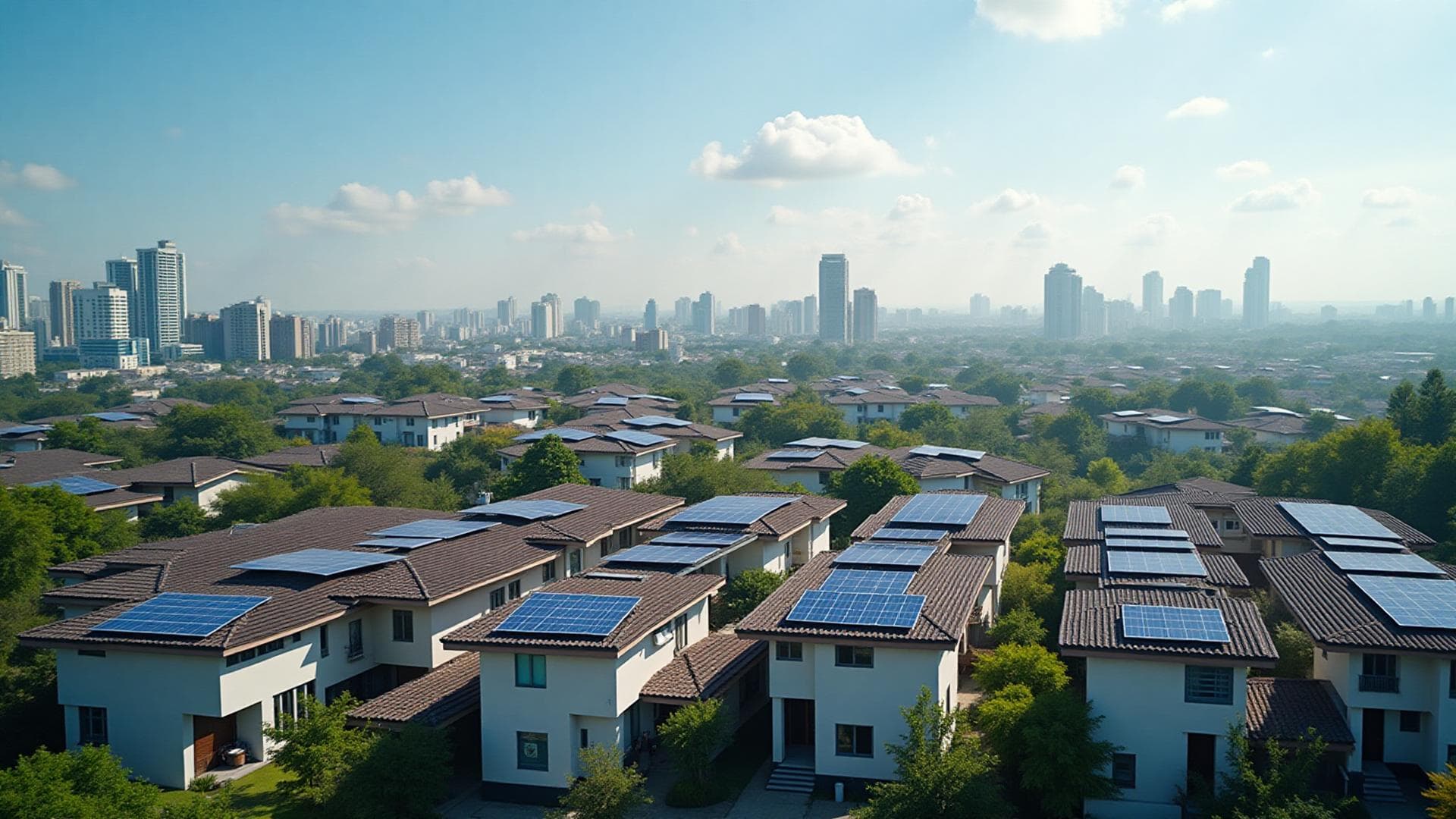

Solar panel financing in the Philippines means going solar today — for as little as PHP 0 down — instead of waiting years to scrape together cash. A quality 10kW residential system runs PHP 400,000–600,000 upfront. Financed over five years, that same system costs roughly what many Filipino families already pay in kuryente. That's the shift solar panel financing Philippines buyers are finally making: from "someday" to right now.
- 5 financing options: bank loans, in-house installment, Pag-IBIG MPL hack, government programs, solar lease
- Sample amortization: PHP 500K financed 5 years at 9% p.a. ≈ PHP 10,400/month
- Break-even: cash buyer year 4, financed buyer roughly year 5.5–6
- No collateral? In-house installment plans need only proof of income — no property required
Bakit Hesitant ang mga Pilipino sa Solar? (And Why That's Changing)

Meralco and VECO rates keep climbing. Solar prices, meanwhile, have dropped more than 30–40% since 2022. Yet a quality 10kW system still carries a PHP 400,000–600,000 price tag — enough to make most homeowners close the browser tab and file it under "someday."
Consider Rommel, a homeowner in Cavite paying PHP 9,000/month in singil sa ilaw — a profile we see constantly. Cash purchase? Hindi agad. But once he looked at financing, his monthly solar payment came out near-identical to his electric bill. The difference: after year five, the solar payment disappears. The electricity stays free.
Financing doesn't cost you more. It restructures a future you were already going to pay for.
Your 5 Financing Options — Magkano Bawat Isa?
1. Bank Loans (BDO, BPI, Metrobank)
Major banks offer home improvement and personal loan products that cover solar installations. Terms typically run 3–7 years at 6–12% p.a., depending on credit profile and whether you pledge collateral. BDO and BPI both have home equity lines suited to larger systems. The trade-off: more paperwork, 2–4 week approval timelines, and usually a property requirement.
2. In-House Installment Plans
The fastest route for most homeowners. Installers like LakaSolar offer in-house payment plans — no bank, no long forms, no waiting. Requirements are straightforward: proof of income and a down payment. Approval in days. Rates are competitive, especially for systems in the PHP 200K–500K range.
3. The Pag-IBIG Multi-Purpose Loan Hack
This one flies under the radar. Pag-IBIG members can borrow up to PHP 80,000 through the Multi-Purpose Loan (MPL) at approximately 10.75% p.a. — one of the lowest consumer rates in the country. You can't pay the full system cost directly through it, but using it as a down payment cuts monthly amortization significantly on any bank or in-house plan.
Under the Renewable Energy Act (RA 9513) and ERC net metering rules, surplus solar power exported to the Meralco or VECO grid offsets future bills with a credit. That accelerates your break-even — whether you paid cash or financed every peso.
4. Government Programs & Net Metering
The DOE and DOST run periodic subsidy programs, particularly for low-income and rural households — though availability varies sharply by region and LGU. For most urban homeowners, the real government benefit is net metering under RA 9513. Exporting surplus energy back to the grid chips away at your bill and shortens payback on any financing plan.
5. Solar Lease vs. Ownership
| Solar Lease | Ownership (Financed) |
|---|---|
| PHP 0 down. You use the power; the installer owns the panels. No asset, no resale value — but zero upfront commitment. | Down payment required. Monthly amortization. But the system is yours — it adds home value and costs nothing after the loan is paid. |
For homeowners who plan to stay put, ownership via financing wins on every long-term metric. Leasing is the right call only when you need absolute zero commitment right now.
Sample Amortization: Gaano Kalaki ang Bayad Bawat Buwan?

10kW @ PHP 500K, 9% p.a., 5 years
(saves from day 1)
(after loan paid off)
The math is blunt. If your current Meralco bill runs PHP 8,000–12,000/month, a financed solar payment of roughly PHP 10,400 is a lateral move — or cheaper than what you're already sending to the utility. After year five? Near-zero kuryente forever.
"The monthly payment on financed solar often lands within range of the electric bill it replaces — and once the loan is cleared, that bill is gone for good."
Sulit Ba? How to Know Which Option Fits You

Two questions determine your best option: your Pag-IBIG status, and your appetite for paperwork.
- Have Pag-IBIG contributions? Borrow through the MPL for your down payment — PHP 80K at one of the lowest rates available anywhere.
- Want approval in 1–3 days? In-house installment with LakaSolar. No bank, no bureaucracy.
- Have property to pledge? A bank loan gets you the sharpest rates — 6–8% p.a. with a clean credit record.
- Renting or uncommitted? Solar lease is your entry point. PHP 0 down, no ownership, minimal risk.
Before signing anything, run the Solar ROI Calculator — your exact break-even shifts with your bill size and system spec. Then get a free LakaSolar quote. Libre ang konsulta, and the team can match you to the right plan without the sales pressure.
Solar panel financing in the Philippines turns a PHP 400K–600K decision into a manageable monthly payment — often no bigger than the electric bill it eliminates. Bank loan, in-house installment, Pag-IBIG MPL as a down payment: all three paths lead to the same destination. After the loan is paid, you own the system. Electricity costs near zero. The sooner you start, the sooner you stop paying Meralco.
Mga Tanong na Madalas Itanong (FAQ)
Can I get a solar panel loan in the Philippines without collateral?
Yes. In-house installment plans from installers like LakaSolar require only proof of income and a down payment — no property pledge. Some banks also offer unsecured personal loans that can fund a solar installation, though rates run slightly higher than secured home improvement loans.
Pwede ba gamitin ang Pag-IBIG loan para sa solar panels?
Hindi direkta, pero may workaround: ang Pag-IBIG Multi-Purpose Loan (MPL) ay maaaring gamitin bilang down payment para sa solar installation. Members can borrow up to PHP 80,000 at approximately 10.75% p.a. — enough to meaningfully lower your monthly amortization on any in-house or bank plan.
How long does it take to break even on financed solar in the Philippines?
With financing, break-even typically lands at 5–7 years depending on your current kuryente bill, system size, and loan terms. A 10kW system at PHP 500K financed over five years at 9% costs roughly PHP 10,400/month — comparable to what many households already pay in electricity. After the loan clears, your power is essentially free for the remaining 15–20 years of panel life.
Are there government programs for solar financing in the Philippines?
The DOE and DOST run periodic subsidy programs for rural and low-income households — but availability shifts by region and budget cycle. The most consistent benefit for urban homeowners is net metering under RA 9513, which credits surplus power exported to the Meralco or VECO grid. That credit shortens break-even whether you paid cash or financed the whole thing.
Run the Solar ROI Calculator to find your exact break-even — then get a no-pressure quote. Libre ang konsulta.
Solar financing in the Philippines has matured — you no longer need PHP 400,000 in cash to go solar. Between SSS loans, PAG-IBIG multi-purpose credit, Pondo ng Nasyunalismo, and bank installment plans, most homeowners can enter a system for PHP 5,000–12,000/month and break even in 5–7 years.
- Best for low monthly cost: PAG-IBIG MPL (10.75% p.a., up to 5 years)
- Best for speed: In-house solar financing (approval in days, not weeks)
- Best for rural households: DOE/DOST subsidy programs when available
- Don't overlook: Net metering credits — they cut break-even regardless of how you financed
Quick Savings Estimate
Get a Free Quote
Custom system design