
Your neighbor lost three panels when Typhoon Carina hit. You didn't — and the difference wasn't luck. Every typhoon season, Filipino homeowners ask the same question: kaya ba ng solar panels ang bagyo? Yes — if the installation is done right. The panel is almost never the problem. Racking is. Connectors are. Inverter placement is. Get those three right and your system survives; get them wrong and you'll be calling your installer the morning after the storm, PHP 20,000 too late.
- IEC 61215-certified panels handle 130–150 km/h — most Signal 3 typhoons fall within that range
- The real risks are loose mounting brackets, exposed cables, and inverter water ingress
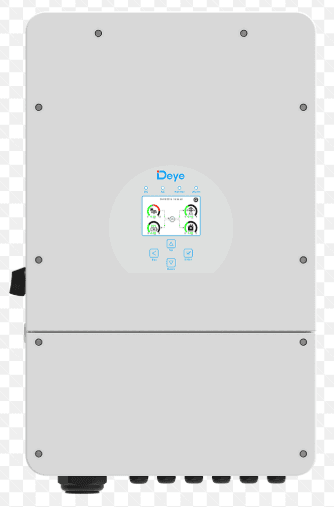
- A hybrid inverter with battery storage (Sungrow, Deye) auto-switches when Meralco or VECO drops — your kuryente stays on
- After the bagyo: inspect before re-energizing — a cracked panel is still live and will shock you
Kayang-Kaya Ba ng Solar Panels ang Bagyo? (What Solar Panels Can Actually Handle)
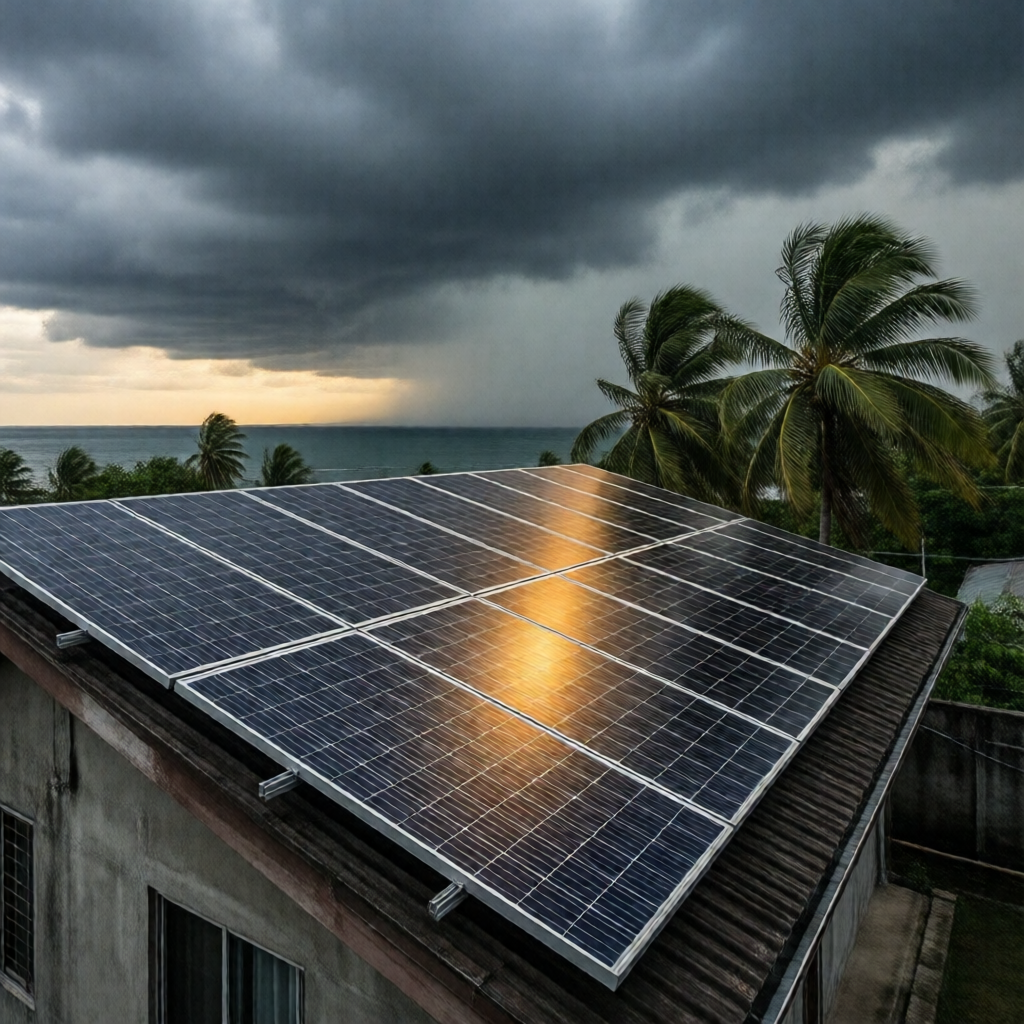
Most tier-1 panels carry IEC 61215 certification — a standard that tests wind resistance at pressures equivalent to roughly 130–150 km/h. A PAG-ASA Signal 3 typhoon runs 121–170 km/h sustained (10-minute average, per the 2020 PAGASA PSWS). So yes, the upper end of Signal 3 and Signal 4 weather can push panels past their rated limits. But panels rarely fail. Racking does.
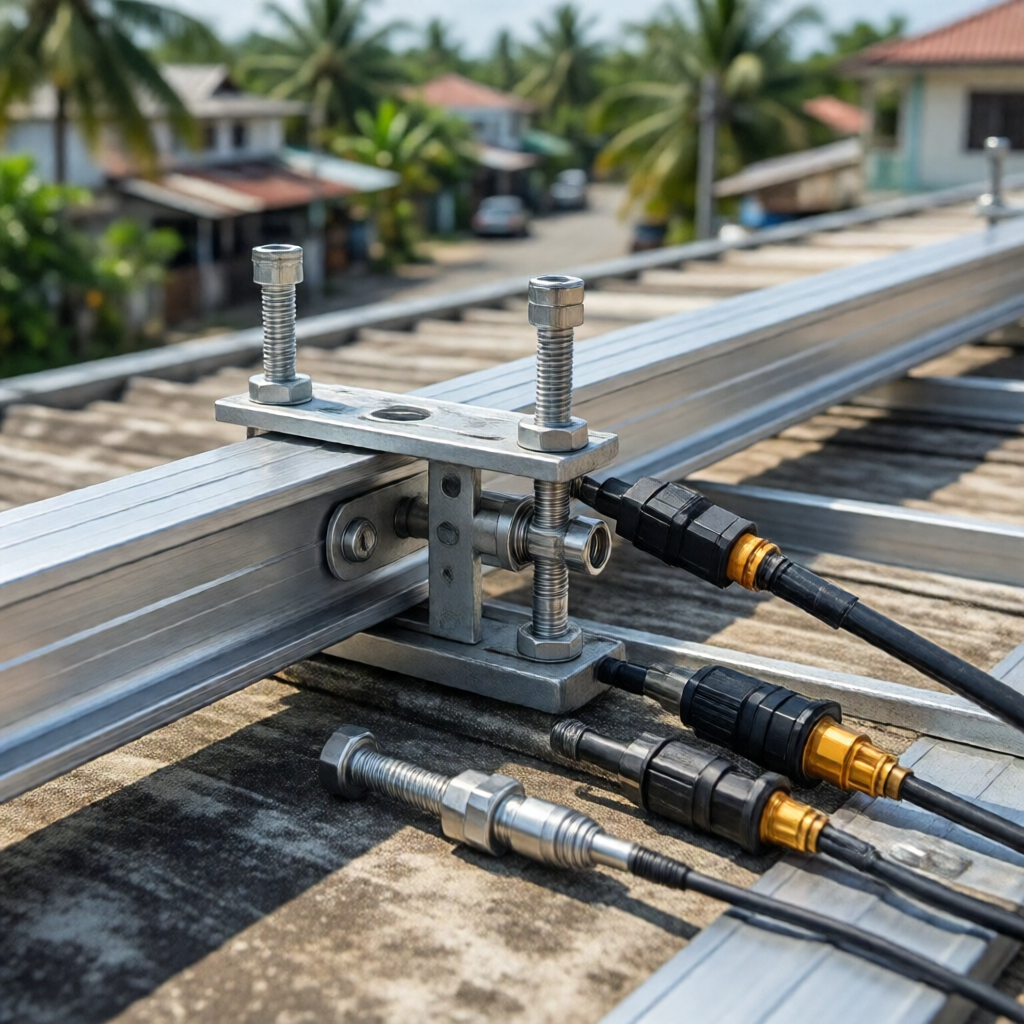
The aluminum mounting rail, the roof clamps, the anchor bolts connecting everything to your structure — that's where typhoon damage almost always starts. A panel rated for 150 km/h bolted to a bracket that wobbles in Signal 2 is already a liability. And then there's the grid angle: Metro Manila outages after a major bagyo routinely stretch 3–7 days. A hybrid solar-plus-battery setup keeps your ref, electric fan, and phone charger running while your neighbors are lining up for ice.
Paano Protektahan ang Iyong Solar System Before a Typhoon (Pre-Storm Checklist)
Do this 24–48 hours before landfall — not the morning it hits.
-
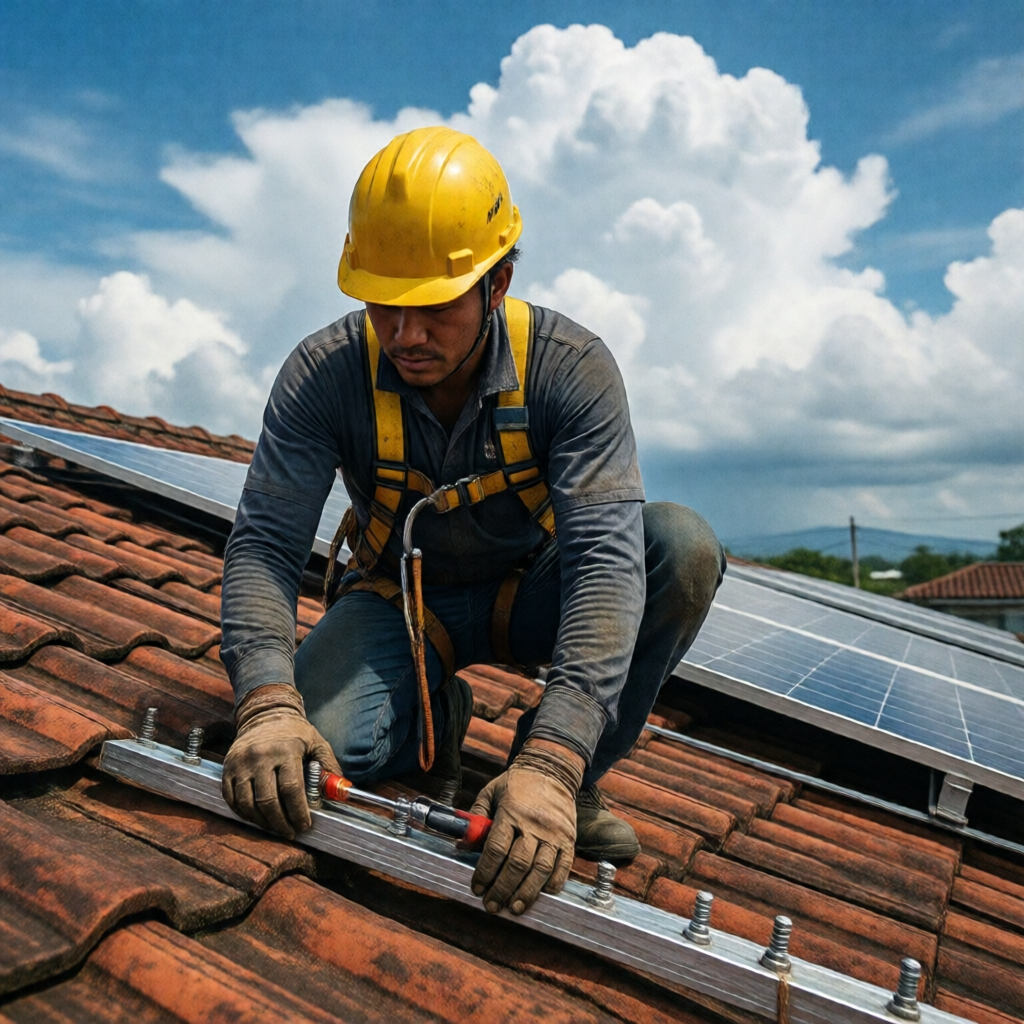
1Inspect mounting brackets and rail clamps. Get on the roof safely and tighten any loose bolts by hand. If a bracket wobbles before the storm, it fails in 150 km/h gusts. Not comfortable with hardware? Call your installer — that's what the service line is for.
-
2Check cable conduits and MC4 weatherproof connectors. Exposed wiring or connectors that aren't fully clicked together invite water into your DC system. Water ingress in DC wiring is a fire risk — not just a performance issue.
-
3Trim nearby trees. A falling branch hits panels with far more force than wind alone. Prune anything overhanging your roof before the season starts — ideally in May.
-
4Do NOT cover panels with tarps. Huwag. A tarp acts like a sail, creating uplift forces that can rip your entire racking system off the roof. It also traps moisture underneath, causing long-term damage that shows up months after the storm.
-
5Switch your hybrid inverter to Battery Priority mode. On Sungrow SH and Deye hybrid series, this charges your battery fully before the grid drops. Open iSolarCloud or SolarmanPV and confirm state of charge is above 80% before landfall.
During and After the Bagyo: What to Do (At Huwag Gawin)
During the storm: Stay off the roof. Your hybrid inverter auto-switches to battery the moment the grid drops — that blinking mode change on the display is completely normal. Monitor battery percentage from the app if you have it. Resist the urge to go outside and check anything.
After the storm, before you re-energize: Walk the roof line from the ground first. Look for cracked panel faces, bent frames, and any DC wiring pulled loose from conduit. If your outdoor inverter enclosure has visible moisture inside — stop. Call your installer before switching anything back on.
A damaged panel can still generate electricity — which makes it a shock hazard. Huwag hawakan without switching off the DC isolator first. It's the red rotary switch near your inverter. Turn it to "OFF" before touching any panel or DC cable after storm damage.
"Homeowners with a 10 kWh battery system kept essentials running for four days straight. That's the real value of solar-plus-storage in the Philippines — not just the singil sa ilaw savings."
Is Your System Actually Typhoon-Ready? (What to Check When Buying)
Still shopping for solar? Three non-negotiables for typhoon country — ask every installer before you sign:
- Racking wind-rated to ≥150 km/h
- Inverter IP65 or higher (outdoor-rated)
- 35mm+ anodized aluminum frame panels
- MC4 connectors fully clicked and conduit-routed
- Roof penetrations sealed with weatherproof flashing
- No wind rating documentation provided
- Inverter mounted outdoors without IP rating
- Cables zip-tied to racking without conduit
- Thin 25mm panel frames (budget-tier)
- "We've never had a problem" without supporting data
A typical case we see: a Batangas homeowner who bought on price alone. After Typhoon Kristine, two brackets had pulled partially free from roof battens — not panel failure, but undersized anchor bolts on concrete tile. Repair: PHP 22,000. The right spec upfront would have cost nothing extra.
Solar panels are built for Philippine weather. But only if the installation is. The panel is rarely the problem — racking, connectors, and inverter placement are where storms find weaknesses. Nail these before June, check them before every major bagyo, and you'll have power when everyone else on your street is in the dark.
Mga Madalas na Tanong (FAQ)
Will my solar panels break during a typhoon?
IEC 61215-certified panels are rated for 130–150 km/h — equivalent to a strong Signal 3 typhoon. The bigger risk isn't the glass; it's the mounting hardware underneath it. Get racking inspected annually, ideally before June when the Philippine typhoon season begins.
Can I use solar power when there's a brownout after a typhoon?
Yes — with a hybrid inverter and battery storage, like the Sungrow SH series or Deye hybrid models. These auto-switch to battery-plus-solar when Meralco or VECO drops. A pure grid-tie system (walang battery) shuts off during a grid outage by design — safety requirement, not a defect.
Magkano ang gastos kung masira ang solar panels sa bagyo?
A single 550W panel replacement runs PHP 6,000–10,000 including labor. Full racking repair after a major typhoon: PHP 15,000–40,000 depending on scope. Most comprehensive homeowner's insurance in the Philippines covers solar as a permanent fixture — document your installation with photos before the season and verify your policy explicitly.
Do I need to do anything special to my inverter before a storm?
On hybrid inverters (Sungrow, Deye, Growatt), switch to "Battery Priority" mode so the battery hits 100% before any outage. For outdoor-mounted inverters, verify the enclosure seal is intact — IP65 is fine in rain, but a broken gasket changes that fast. IP54 or unrated? Add a weather cover.
Every typhoon season is a reminder that solar in the Philippines isn't just about saving on your singil sa ilaw — it's about having power when the grid goes down. The technology handles Philippine weather fine. The question is whether your installation does.
Is your system built for typhoon season?
Get a free site assessment from LakaSolar. Every system we design is spec'd for Philippine weather — racking, inverter placement, cable management, and all.
Book a Free Assessment →The Bottom Line
- Philippine solar panels handle typhoons well — racking and installation quality are the real variables
- Use G550 galvanized steel with 4–6 anchor points per panel minimum; verify wind load ratings before signing
- Hybrid battery systems keep you powered through outages; pure grid-tie does not
- Set battery to 100% charge before a storm hits; physically check inverter seals each season
- Document your installation with photos — your homeowner's insurance requires it
Quick Savings Estimate
Get a Free Quote
Custom system design