
Your solar panels are bolted to your roof. A Signal No. 4 bagyo is coming. The one question every Filipino homeowner should ask before install day — not after — is: will they hold? The honest answer lives entirely in your panel specs and your racking system. Not in what the salesperson told you.
- Look for ≥5400 Pa wind load rating — minimum for Signal 3 areas like Luzon and Eastern Visayas.
- IP67 or IP68 water ingress rating protects against monsoon rain and flooding splash.
- Panels must carry IEC 61215 + IEC 61730 dual certification for net metering eligibility with Meralco or VECO.
- Certified panels cost more upfront (PHP 6,000–10,000 installed per panel) but one bagyo replacement wipes out any savings from going cheap.
- Even a perfect panel fails if the racking system isn't rated for local conditions — demand a structural load calculation from your installer.
Kaya Ba ng Solar Panels ang Bagyo? What the Ratings Actually Mean
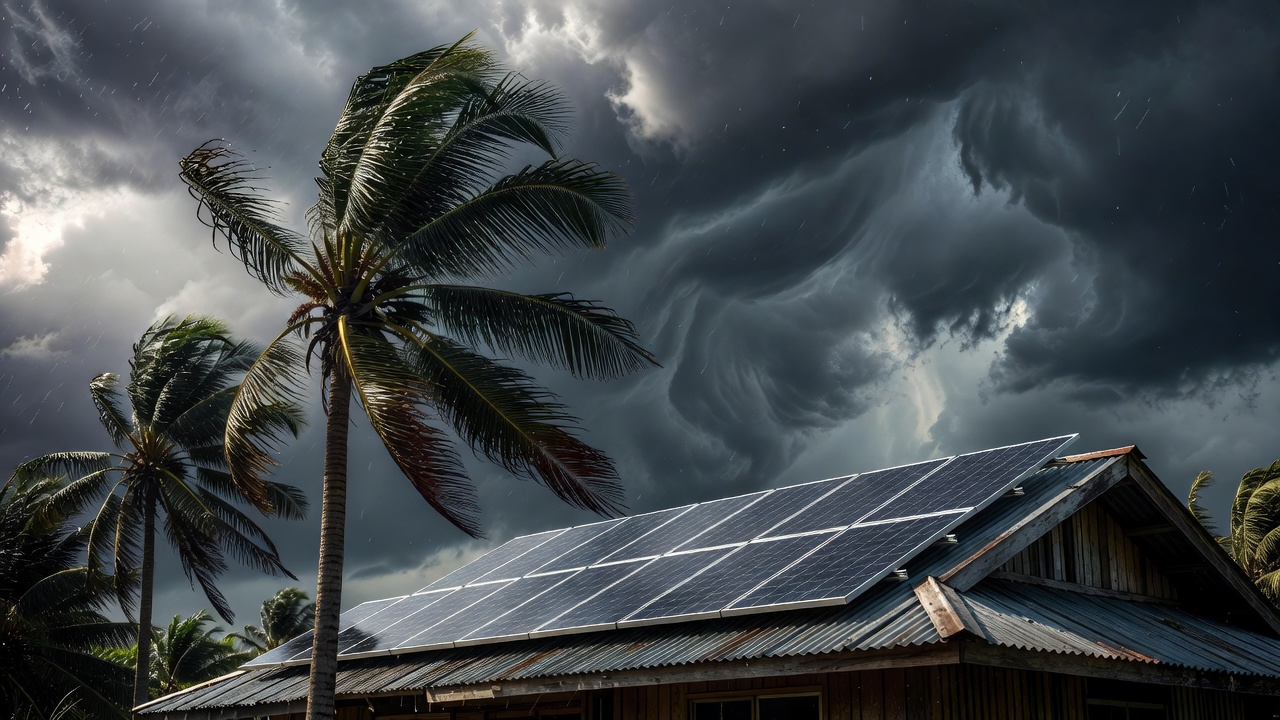
The Philippines sits dead center in the Pacific typhoon belt. Twenty typhoons cross the Philippine Area of Responsibility every year. Signal No. 3 through 5 means sustained winds of 100–200+ kph — enough to strip CGI roofing sheets, snap branches, and rip poorly-mounted solar panels clean off your roof. This is not a worst-case scenario. This is a Tuesday in Bicol.
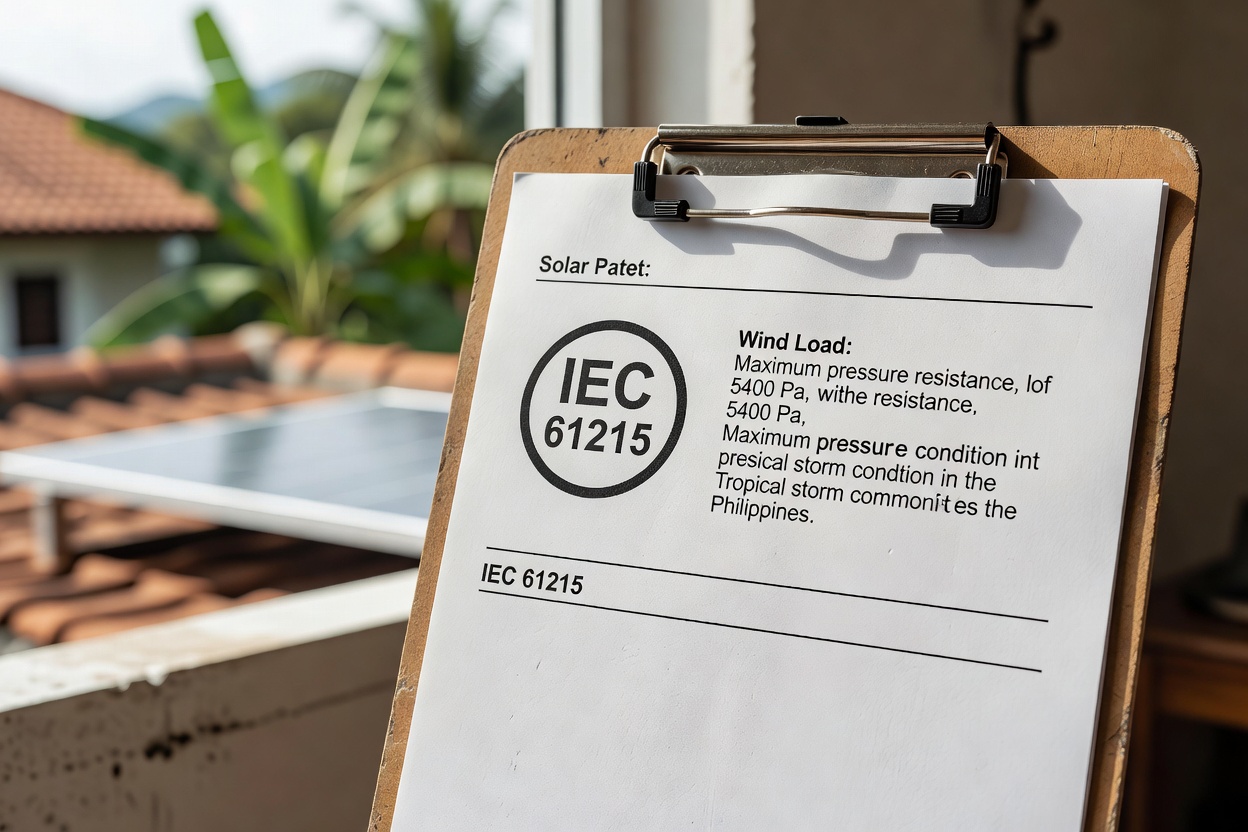
Two specs determine whether your panels survive. First: wind load rating, measured in Pascals (Pa). This is the pressure a panel withstands — wind pushing against the front face and the vacuum pulling upward from the rear. The IEC 61215 standard sets the international benchmark. For typhoon country, you want panels rated at ≥5400 Pa front / 2400 Pa rear. Budget no-brand panels often list no IEC certification at all. That's not a minor detail — that's a dealbreaker.
Second: IP rating for water ingress. IP67 means the panel survives submersion up to 1 meter for 30 minutes. IP68 goes deeper. The Philippines receives 1,500–3,000mm of rainfall annually. Monsoon rain is not a garden sprinkle. Minimum IP67 — no exceptions.
Typhoon-Ready Solar Panel Checklist: What to Look For
Forget brand names. Brands get repackaged, rebadged, and resold under a dozen different labels. Specs don't lie. Verify these six items before you sign any installation contract.
-
1
Wind load ≥5400 Pa front pressure. The minimum for any barangay in a regular typhoon signal zone. Premium monocrystalline panels reach 6000 Pa — worth every peso in Bicol, Samar, or Northern Luzon.
-
2
IP67 or IP68 water ingress rating. Panels that can't handle sustained monsoon downpour will fail long before a bagyo turns serious. No IP rating on the datasheet? Walk away.
-
3
IEC 61215 + IEC 61730 dual certification. IEC 61215 covers electrical performance; IEC 61730 covers safety durability. Meralco-accredited installers and VECO net metering applications require certified equipment. Skip this and your application may be rejected outright — your entire investment earns nothing from the grid.
-
4
Tempered anti-reflective glass, minimum 3.2mm. Standard glass won't stop hail or wind-driven debris. The industry baseline is 3.2mm tempered. Some typhoon-grade panels use 4mm. Either one beats standard glass every time.
-
5
Aluminum alloy frame — not plastic clips. Frame failure is how panels detach. A full aluminum perimeter frame distributes wind load across the entire structure. Plastic corner clips and flimsy channels become a liability the moment winds pass 150 kph.
-
6
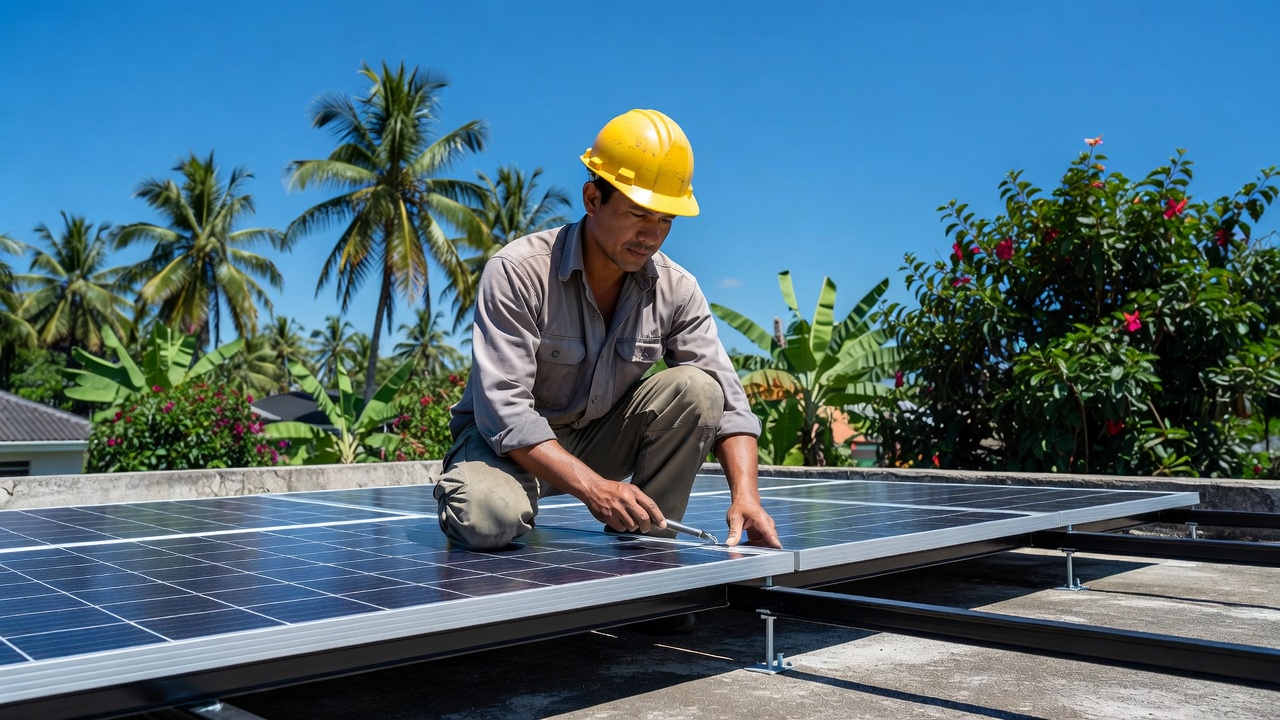
Racking system certified for local conditions. Demand a structural load calculation for your specific roof — concrete hollow block, CGI (yero), or wood. The best panel on the market will still fly off a roof if the mounting rail pulls out. Ask for the document. No document, no deal.
"Ang panel lang ang bibilhin mo — ang bagyo, kasama na sa package. Design for it from day one."
One more item for flood-prone barangays: ask your installer about panel height clearance. Floodwater itself rarely destroys a properly rated panel. Debris carried by that floodwater is an entirely different threat.
Sulit Ba? Cost vs. Durability Tradeoff for Filipino Buyers
Here's the math, straight. A certified typhoon-resistant panel — monocrystalline 400W, full IEC ratings — runs PHP 6,000–10,000 per panel installed, depending on brand and installer margin. Uncertified budget panels start around PHP 3,500–5,000. On a 10-panel system, that's a PHP 20,000–40,000 gap at the point of purchase.
That gap disappears after one Signal 4. Replacing just five damaged panels post-bagyo — labor, potential roof repairs from detached mounts, system downtime — runs PHP 50,000–100,000 easily. One bad storm erases three years of upfront savings. The arithmetic is brutal.
A Leyte homeowner installed uncertified panels in 2023 to cut initial costs. When a strong typhoon crossed Eastern Visayas, two panels tore free and punched through the roofing. The repair and replacement bill exceeded the original savings by a wide margin — and the new installation required certified panels regardless, for the net metering application the homeowner had been counting on from the start.
Ang singil sa ilaw mo ngayon versus ang repair cost bukas. The math is not close.
Wind Rating: ≥5400 Pa — documented
Warranty: 10yr product / 25yr performance
Net Metering: Eligible (Meralco/VECO requirement)
Wind Rating: Unlisted or unverifiable
Warranty: Often 1–2yr, limited coverage
Net Metering: May be disqualified
The DOE's net metering framework (Department Circular DC2013-05-0009, as updated) requires installers to submit panel datasheets with IEC certification numbers as part of the accreditation file. No certification number, no accreditation. It's a paper trail that starts at the panel spec sheet — which is one more reason to demand it from your supplier before you pay a deposit.
The checklist above is non-negotiable for any home in Luzon or Eastern Visayas — ang dalawang rehiyon na pinaka-tinatamaan ng bagyo sa buong bansa. Prioritize IEC-certified panels with ≥5400 Pa wind load, IP67 water rating, and a racking system backed by a structural load calculation. A quality install today protects both your roof and your Meralco savings for 25+ years.
Frequently Asked Questions
What wind speed can solar panels withstand in the Philippines?
A 5400 Pa IEC mechanical load rating is the test benchmark for typhoon-grade panels — it represents the combined front pressure and rear uplift the panel must survive without deformation, and it comfortably exceeds the dynamic wind loads generated by Signal No. 3–4 conditions. Higher-rated panels at 6000 Pa provide additional margin for the most intense Signal 4 and 5 events. The manufacturer spec sheet is your most reliable reference — request it before purchase, not after.
Do solar panels get damaged by heavy rain and flooding?
Panels with IP67 or IP68 ratings are sealed against water ingress under normal monsoon conditions. The greater threat is wind-driven debris and mount failure, not rain. In flood-prone areas, panels should be mounted high enough to avoid direct contact with debris-carrying floodwater — your installer should assess site elevation before quoting.
Will my solar panels still work after a typhoon passes?
Certified panels that survive intact typically resume normal output once the sky clears. After any Signal 3+ event, have a licensed electrician inspect the wiring, junction boxes, and racking connections before restarting your system. Micro-cracks from debris impact are invisible to the eye but degrade output over time — schedule a post-typhoon performance check. It's worth it.
Use our solar calculator to estimate your savings — then ask your installer to verify every spec on this checklist before you sign.
Calculate Your Solar Savings →The Philippines is one of the best solar markets in Asia — but typhoon season punishes systems that cut corners. A panel that passes IEC 61730 and carries a legitimate 25-year warranty from a brand with a local service presence is not more expensive in the long run. It's cheaper.
- Demand wind and snow load ratings in writing — minimum 5400 Pa for most Philippine provinces
- Verify warranty coverage is backed locally, not just by an overseas head office
- Book a post-typhoon performance check after any Signal 3+ event
- Run the numbers on your actual bill before committing to any system size
Quick Savings Estimate
Get a Free Quote
Custom system design