

Your solar panels are producing more kuryente than your household can absorb — and right now, that surplus is evaporating into nothing. Net metering Philippines Meralco 2026 rules fix that. Send your excess power back to the grid; Meralco credits it against your singil sa ilaw. The question isn't whether to apply. It's why you haven't already.
- Net metering lets solar owners send excess power to Meralco as bill credits — not cash.
- The export rate is roughly PHP 5.00–6.50/kWh, about half the retail rate you pay.
- Meralco cannot legally refuse applications for systems 100kW and below.
- The process takes 30–60 days; Meralco installs the bidirectional meter at no cost to you.
- Net metering is a bonus. Your main savings come from self-consumption, not from exporting.
Ano ang Net Metering at Paano Ito Gumagana?
Net metering is a billing mechanism enshrined in Republic Act 9513 (Renewable Energy Act) and enforced through ERC implementing rules. When your panels produce more electricity than your home is drawing at that moment, the surplus flows onto the grid. Meralco — or VECO, DLPC, and any other distribution utility — measures what you exported and posts it as a credit against your next bill.
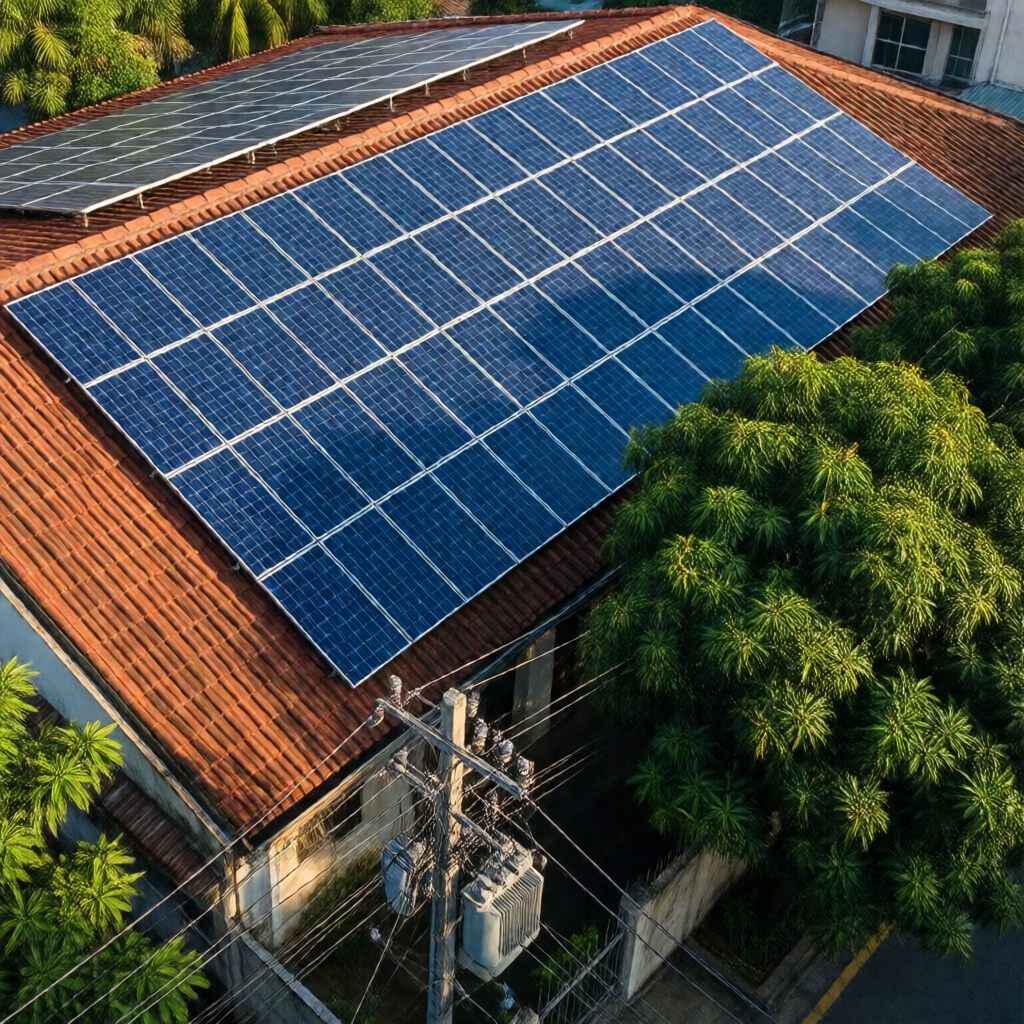
The program covers any distributed generation system up to 100kW — virtually every residential and small commercial installation in the country. Think of it as a kuryente savings account: deposit surplus energy during peak sun hours, draw down the credit at night or on overcast days.
Step-by-Step: How to Apply for Net Metering with Meralco
Magkano ang Matatanggap Mo? Net Metering Credits Explained

Here's where homeowners get surprised — sometimes pleasantly, sometimes not. Meralco doesn't credit your exports at the rate you pay them. They use the avoided cost rate: approximately PHP 5.00–6.50/kWh in 2026. Your retail rate sits at roughly PHP 11–12/kWh. That gap is real. Build your expectations around it.
That math assumes roughly 90 kWh exported monthly. It's a real offset — not a revenue stream. Credits roll forward month to month, netting off your bill. You'll feel it most when production peaks. And at year-end, any remaining balance can be monetized at the avoided cost rate, so nothing disappears.
"Net metering credits are a bonus discount on your bill — generous when the sun cooperates, but the real money is every Meralco kilowatt you never have to buy."
Sulit Ba? Is Net Metering Worth It for Filipino Homeowners?

Honestly? Net metering alone won't recoup a PHP 200,000–400,000 solar investment. Not at PHP 5–6.50/kWh export rates. The sulit is in self-consumption: every kWh your panels produce that you use directly saves you the full PHP 11–12/kWh retail rate. That's where the payback math actually works.
Net metering earns its place for households that can't shift all consumption to daylight hours. WFH setups running aircon all day. Small businesses that also operate at night. Heavy daytime loads that occasionally spike past live production. Take a home-based bakery in Antipolo: equipment runs 6am–2pm, panels peak 9am–3pm, and the household exports a predictable 80–100 kWh monthly. Net metering adds PHP 400–600/month on top of the direct savings. Sulit na sulit — but notice what's doing the heavy lifting.
If maximizing self-use matters more than exporting, battery storage deserves a hard look. Store excess solar for nighttime use at the full retail rate rather than selling it back at half-price. Higher upfront cost. Often a better return.
Net metering is a legitimate perk of going solar — not the primary return. Apply for it. You're legally entitled to it, and setup costs you nothing. But size your system to maximize what you consume, not what you export. The homeowners seeing the best ROI treat net metering as a bonus, never a business model.
Frequently Asked Questions
How much does Meralco pay per kWh for net metering in 2026?
Meralco credits exported solar energy at the avoided cost rate — approximately PHP 5.00–6.50/kWh in 2026. The ERC sets this figure. It's lower than the retail rate you pay (roughly PHP 11–12/kWh), and the credit appears as a bill deduction. Meralco doesn't send a check.
How long does a net metering application take in the Philippines?
From complete submission to meter swap, the ERC-mandated maximum is 30–60 days. Incomplete paperwork is the single most common cause of delays — submit a clean, complete application the first time and the timeline holds.
Can I apply for net metering with VECO or other distribution utilities?
Yes. Net metering is a national program under RA 9513 that every distribution utility in the Philippines — VECO, DLPC, and others — is legally required to offer for systems up to 100kW. The application process and required documents are substantially the same; timelines vary by utility.
Can I still use net metering if I have a battery storage system?
Yes, but your setup must export excess generation directly to the grid — batteries cannot be the source of exported power under current ERC rules. Most installers configure hybrid systems so solar charges batteries first, then exports remaining surplus. Meralco and other DUs require disclosure of battery storage during the application.
Ready to start earning credits on your singil sa ilaw?
Get a free net metering assessment — we handle the paperwork, accreditation, and Meralco coordination from day one.
Get a Free Net Metering Assessment →Bottom Line
Net metering is the most reliable way to reduce your Meralco bill with solar — but only if you understand the rules. Export credits are real but modest. The real savings come from consuming your own generation before it ever hits the grid.
- Size your system to your consumption, not your roof
- Submit a complete application to avoid 30+ day delays
- Credits appear as bill deductions — not cash payments
- Every DU in the Philippines is legally required to accept your application
Quick Savings Estimate
Get a Free Quote
Custom system design


